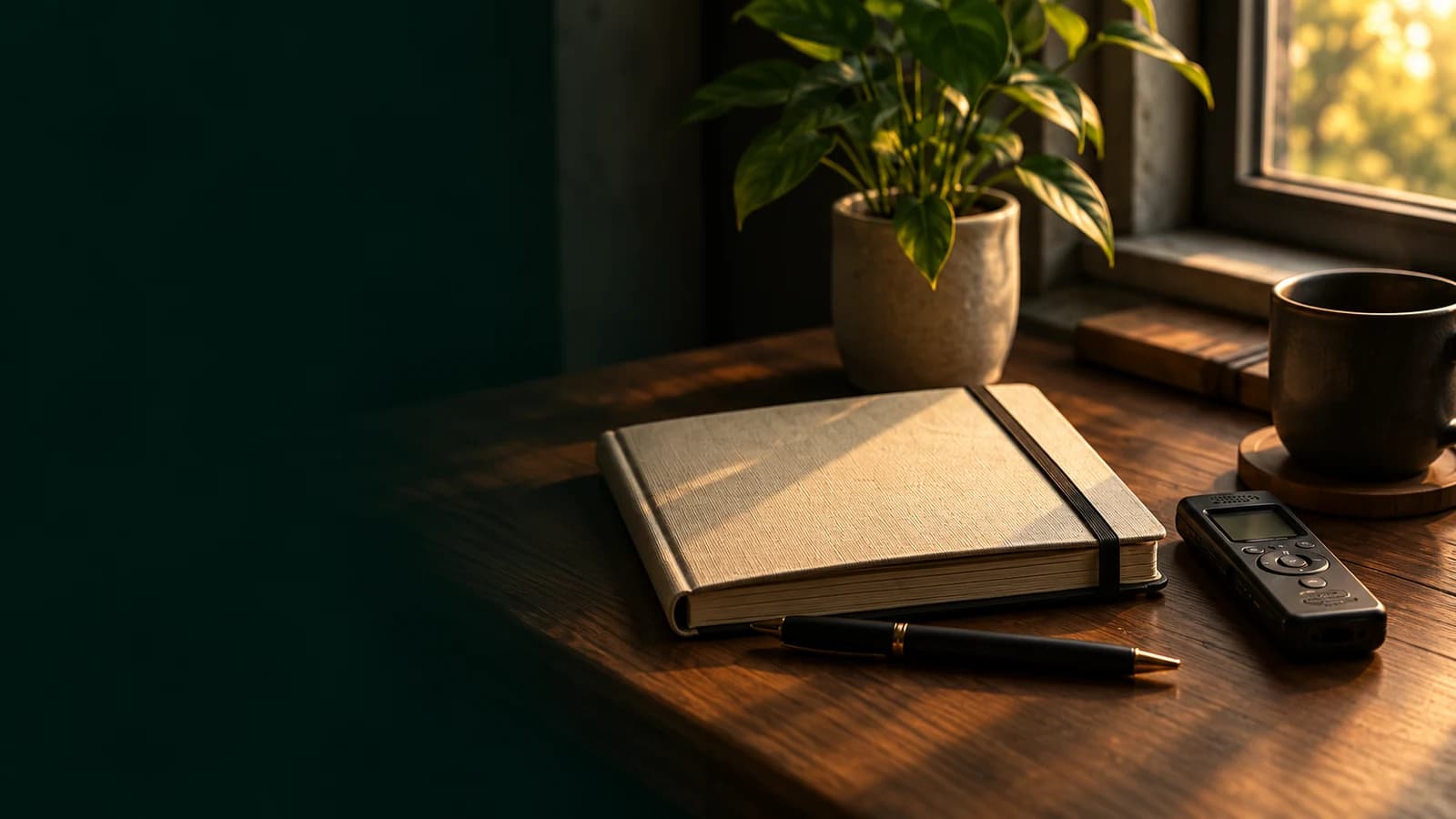
The best format is the one you will return to
A notebook may suit quiet, searchable reflection. A voice memo may suit a half-awake fragment or a detail that arrives faster than writing. Neither records a fuller dream by definition.

Record
Capture the first available detail.

Notice
Choose a format that fits the moment.
A journal does not have to look like a bound book. It can be a page beside the bed, a dated audio file, or a combination of both. The useful question is not which format is more serious; it is what helps you make a clear record without making the morning harder.
Writing and speaking create different kinds of material. A notebook gives visible words and space for a sketch. A voice memo catches pace, pauses and wording before you feel fully awake. You can choose one for most mornings and still use the other when it serves the fragment better.
Choose by the job you need it to do
Use a notebook when you want a quiet, compact entry, a drawing, or a page you can scan later. Use a voice memo when getting words down matters more than spelling, light or posture. If speaking would disturb a bed partner or someone nearby, a notebook or a very short whispered note may be the kinder choice.
You do not need to commit permanently. Keep one primary format and a small fallback. For example, record a thirty-second memo when you wake, then write a dated line later saying that it was transcribed from audio.
What a notebook makes easy
Paper is immediately visible: you can underline a phrase, draw the layout of a room, put a question mark beside a doubtful detail and compare pages without opening an app. It also gives you a physical object whose storage you control. A small notebook and pen can be enough for a fragment such as ‘orange corridor; laughter; ending missing’.
The trade-off is friction. You may not want to switch on a light, search for a pen or write a long account while tired. A page can also become difficult to search unless you add a date, a simple title or a few repeated headings.
What a voice memo makes easy
Speaking can preserve a sequence before you decide how to organise it. You may catch uncertainty in your own words: ‘I think there was a dog, or perhaps only barking.’ A memo can also be useful when handwriting is uncomfortable or when a scene has a rhythm you want to hear again.
Audio needs a little housekeeping. Rename or date the file promptly, and say the date at the beginning if names are not reliable. If you transcribe it, keep the audio as the original and label the written version as a later transcription rather than editing the spoken account into a cleaner memory.
Consider consent when other people may be audible. A recording of your own note can still capture a partner, child or housemate in the background. Stop, move somewhere suitable or leave that part out rather than treating another person’s voice as journal material.
What one format study found
Schredl and colleagues (2019) randomly assigned 45 people to a week of written or voice dream reports and analysed 40 participants: 22 written and 18 voice. Voice reports contained more words, while written reports had more reports and more waking links. The short, small, non-representative study had much missing demographic information. Report length is not a measure of accuracy or dream volume, and the recording devices were not necessarily phones. Schredl et al. (2019)
The study is a useful reminder that formats can shape what is recorded. It does not pick a winner for every person or guarantee a change in recall.
Make later review practical
Give every entry a date and one plain label: ‘bridge’, ‘green room’ or ‘no content recalled’. For audio, use the same words in the file name or the first sentence. For paper, add a margin tag. This makes it easier to return to a specific account without relying on a dramatic title you may later forget.
Can I find this again?
Add a date and a few ordinary words that describe the fragment.
Which version is original?
Keep the first audio or page, then date any transcription, expansion or drawing.
Would recording here affect someone else?
Choose silence, a different room or a later note if another person needs rest or privacy.
A simple hybrid routine
A hybrid approach can be deliberately small. Record a memo containing only the image, action and uncertainty. Later, copy the parts you want into a notebook and add a separate reflection. The first version remains a time-stamped record; the second becomes a readable journal page.
Date and waking time:
Original format: paper / audio
First fragment:
Words or details I am unsure about:
If transcribed, date of transcription:
Later reflection, kept separate:
Let convenience be a real criterion
A format that is slightly imperfect but usable at the right moment can be more helpful than an ideal system you avoid. Try one method for a few ordinary mornings, then notice what it captures and what makes you hesitate. Change the setup, not the meaning of the dream, if the format is getting in the way.
The journal’s first task is to give the available fragment somewhere to land.
Sources and further reading
- Schredl et al. (2019)Voice-recorded vs. written dream reports: A research note. A one-week format comparison, not a measurement of report accuracy.